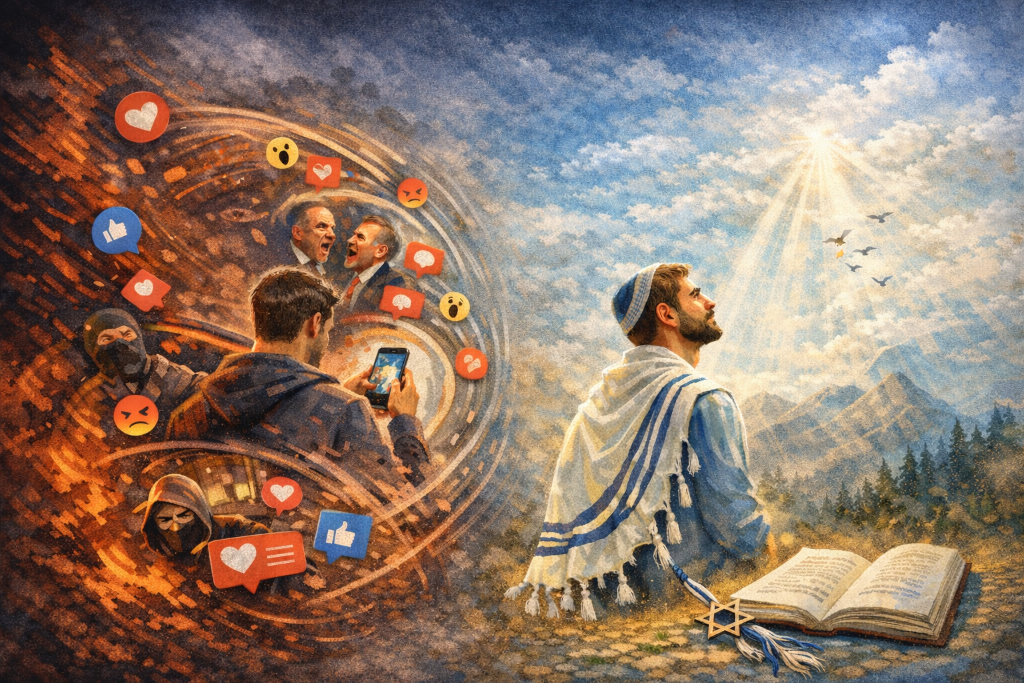
"And You Shall Support Him" — Parashat Behar and the Age of UBI
When the Torah preceded Silicon Valley by two thousand years — Parashat Behar and the UBI principle: preventing a fall is infinitely better than picking up the fallen.
When the Torah Preceded Silicon Valley by Two Thousand Years
In 2025, the Wall Street Journal published an alarming survey: only 20% of workers reported feeling confident in their ability to find a job. That same year, major tech companies laid off thousands of white-collar employees, and AI models began performing tasks once considered exclusively human. The question arising at every tech conference, every economics podcast, and from nearly every Silicon Valley leader is: what will happen to all the people left behind?
The solution proposed again and again is UBI (Universal Basic Income): every member of the population receives a fixed minimum income, with no work requirements or means testing. Musk, Altman, Hoffman — they're all talking about it. But before we dive into the modern economic debate, it's worth pausing to ask: is this idea really new?
Parashat Behar offers a surprising answer.
"Do Not Let Him Sink and Fall"
At the heart of Parashat Behar lies a verse that appears simple yet is profoundly deep:
"And if your brother becomes poor and his means fail him — then you shall support him" (Leviticus 25:35)
Rashi, following the Sifra, offers a sharp interpretation: "Do not let him sink and fall, for it will be difficult to raise him up again; rather, support him at the moment his hand begins to falter. To what is this comparable? To a burden on a donkey — while it is still on the donkey, one person can hold it and keep it upright; but once it has fallen to the ground, even five people cannot lift it."
This is a revolutionary philosophical principle. The Torah did not say "raise up your brother who has fallen" — it said "support him": take hold of his hand before the fall. The best help is preventative, not reactive. Not charity after the fact, but a built-in safety net from the outset.
"You Shall Support Him" — Not Charity, but a Mechanism
The Chofetz Chaim explains the commandment: "One should endeavor with all that is in his power to support his fellow so that he does not collapse under the weight of his poverty... 'Blessed is he who considers the poor' — and why does it not say 'Blessed is he who gives to the poor'? Because the meaning is to contemplate the plight and lowliness of the poor person, to see if perhaps something can be done to raise him from his poverty."
"Who considers the poor" — to understand, to analyze, to identify the trembling point before the fall arrives. This is social intelligence, not sentimentality.
There is an additional innovation here: support him through a loan, or provide him with a source of livelihood, and do not allow him to fall and become dependent on charity. The goal is not to make him reliant on the generosity of others, but to keep him independent. Not dependence — self-sufficiency.
And What Does the Maggid of Dubno Say?
The Maggid of Dubno explains why the Torah placed this verse adjacent to the laws of the Sabbatical year: during the Shemitah, a person implants in his heart faith and trust in the Creator. There is therefore a concern that when a poor person comes seeking support, one might respond by telling him to trust in God. The Torah therefore says "and you shall support him" — the quality of trust is for oneself alone, but when your brother becomes poor, do not rely on trust alone; rather, you yourself must support him.
In other words: personal faith is not an excuse for social irresponsibility. "God will help" is not public policy.
Back to 2026: Who Is Falling?
Automation is one of the central concerns in modern societies, due to its far-reaching effects on income, employment, and productivity. But the deeper problem is not merely economic. A person who loses their job loses also their identity, their structure, their sense of worth. They become "poor" — not only in money but in spirit.
One of the central justifications for UBI is the belief that automation may cause technological unemployment and create a world with fewer paid jobs. As early as 2017, Elon Musk said at the World Government Summit that AI and robots would gradually eliminate categories of work, and therefore "some kind of basic income is necessary."
But here, Parashat Behar is more precise than any technological discourse: UBI as currently proposed is largely reactive — money is given after the crisis has already occurred, after the job has already disappeared. The Torah demands a preventative mechanism: "and you shall support him" — before the hand falls.
The Difference That Changes Everything
It is told of Benjamin the Righteous that he gave a poor woman not only money, but the means by which she could continue generating income. The ministering angels declared that "he had kept alive a woman and her seven children" — a one-time gift helps for a short while, but help that enables ongoing action is called by the name "life."
This is the nuance missing from most UBI discourse: it is not merely about a monthly sum of money. It is about preserving dignity, independence, and the ability of a person not to feel as though he has "fallen to the ground" with "five people unable to lift him."
True UBI, according to the principle of "and you shall support him," is neither charity nor a source of shame. It is a foundational condition for a society that recognizes that human capacity, in the age of automation, should not be measured solely by its ability to compete with a machine.
Conclusion
Parashat Behar, given at Mount Sinai, knew nothing of artificial intelligence. But it knew something we still struggle to accept: that preventing a fall is infinitely better than lifting the fallen. That a social safety net is not a society's weakness — it is its backbone.
"And you shall support him" — three words that, two thousand years later, in an age of unprecedented technological revolution, ring as sharp and relevant as the day they were spoken at Mount Sinai.