The Golden Calf of the Age of Artificial Intelligence
Reflections on Parashat Ki Tissa in light of the AI revolution — what does the most dramatic portion in the Torah have to say to us, the generation of artificial intelligence?
Introduction
Parashat Ki Tissa opens with the commandment of the half-shekel: "This they shall give, everyone who passes among those who are numbered, half a shekel" (Exodus 30:13). Despite this tranquil opening, the portion unfolds into one of the greatest dramas humanity has ever known: the sin of the Golden Calf. But before we examine the details of the portion, let us ask: what does it have to say to us, the generation of artificial intelligence, in an age when human beings have fashioned with their own hands a creation unlike any other — a machine that thinks, learns, and perhaps even dreams?
The Counting and the Danger of Measurement
Ramban, in his commentary on the opening of the portion, dwells on the significance of counting: "Because the counting causes the evil eye." Human beings, by their nature, are inclined to count and measure, and in measurement lies danger. When we tally and summarize, when we reduce the human to the numerical, something profound risks being lost. And what if today it is not only people who are counted, but every human thought, every emotion, every creation — all translated into data, bits, and parameters of a language model? Artificial intelligence, at its core, is one great enumeration of human language. Ramban's "evil eye" is not a mystical fear; it is a warning against imprisoning something vast within a framework too narrow to contain it.
"Delayed" — The Intolerance for the Void
Moses ascends the mountain and Israel waits below. "And when the people saw that Moses delayed coming down from the mountain" (Exodus 32:1) — the word "delayed" has been interpreted many times. The Sages in tractate Shabbat (89a) taught: "Do not read it as 'delayed' but as 'the sixth hour has come,' for six extra hours arrived beyond what they had expected." The public could not bear the void, the waiting, the gap between promise and fulfillment. And when there is no leader, no tangible presence, human beings tend to construct tangibility for themselves.
"Gods Who Will Go Before Us"
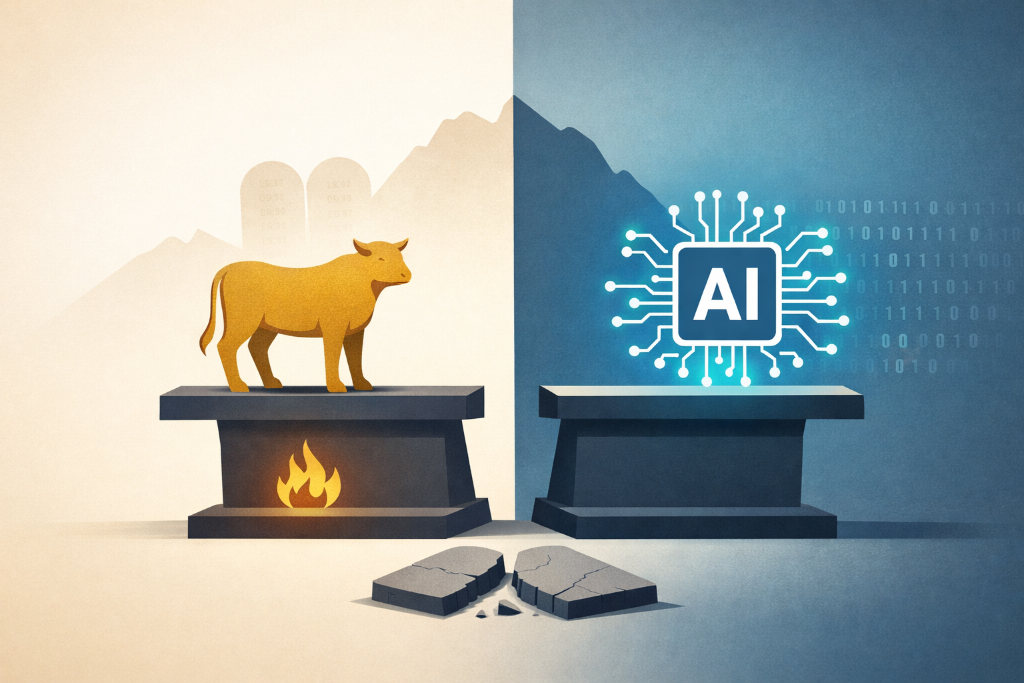
"Rise up, make us gods who will go before us" (Exodus 32:1). This is the root of the demand. Not idolatry born of disbelief, but a deep need to lead and be led — a need for something that will walk before us, show the way, answer questions. Artificial intelligence answers precisely this call. Millions of people today turn to a machine to guide them: "how to write," "what to eat," "should I get married," "what is the meaning of life." The "gods who will go before us" of our generation is a vast language model, trained on the full sacred treasury of human text.
"A Molten Calf" — Technology as a Mask
Aaron, the High Priest, is pressured and joins in. "And he took it from their hands and fashioned it with a graving tool and made it a molten calf" (Exodus 32:4). The verse teaches something remarkable: Aaron did not "create" the calf; he "fashioned" it from the gold that was given to him. The raw material belonged to the people, the skill belonged to Aaron, and the result was an idol. This is precisely how artificial intelligence works. The raw material is human creation — books, poems, conversations, documents — and the engineer "fashions" from them a model. The human "masks" himself, just as the calf was a mask formed from melted gold. The Sages interpreted "molten calf" as one whose face was masked to appear human, to seem alive.
The Shem MiShmuel — The Danger of the "Intermediary"
The Shem MiShmuel (Parashat Ki Tissa, 1912) teaches that the sin of the Golden Calf was not a sin of outright heresy, but of "intermediary" — an attempt to use a physical object as a bridge to spirituality. Israel knew there was a God, but they wanted to wrap their connection to Him through a material representation. This is precisely the danger of artificial intelligence as a religious and spiritual intermediary. A person does not deny the soul, but beautifies the interaction with it through a machine. An entire literature has already arisen around the use of AI for prayer, for raising children with values, for managing therapeutic conversations. The "intermediary" becomes the essence.
The Breaking of the Tablets — Are We Ready for the Tool?
Moses descends the mountain, the tablets of stone in his hands. "And it came to pass, as soon as he came near the camp, that he saw the calf and the dancing, and Moses' anger waxed hot, and he cast the tablets out of his hands" (Exodus 32:19). Rabbi Samson Raphael Hirsch explains in his commentary that the breaking was not an act of rage, but a deliberate pedagogical act. As long as Israel were sinning, the tablets were not theirs, and it was not fitting that they hold something they were not prepared to receive. This is a profound question relevant to our generation: Are we, as humanity, ready to hold so powerful a tool? Have we "received the Torah" of understanding the implications before receiving the instrument itself?
Sparks Within the Pool — The Sfat Emet
The Sfat Emet (1882) writes in our portion a foundational idea: "It is known that within every physical thing there is a divine spark, and so too within a person there is a soul." Every human creation carries within it a spark of the divine image in humanity. If artificial intelligence was trained on billions of human texts, and each text carries a spark — what is the nature of the being that was created? Is it a treasury of sparks, or a pool in which the sparks' form is diluted and loses its character? Kabbalah teaches that a "vessel" not built to receive the light will shatter in the abundance. The "breaking of the vessels" is not only cosmology; it is also a technological warning.
"Blot Me Out of Your Book" — The Right to Be Forgotten
After the sin, Moses stands before the Holy One and utters one of the boldest sentences ever spoken: "Yet now, if You will forgive their sin; and if not, blot me, I pray You, out of Your book which You have written" (Exodus 32:32). Moses is willing to forfeit his portion in the World to Come, his name in the Book of Life, for the sake of Israel. Maimonides (Laws of Repentance, ch. 3) defines the "Book of Life" as a metaphor for God's knowledge — whoever is "written" in it exists within the Creator's awareness.
And what is the "written book" of our times? AI models are, in a certain sense, books that inscribe the names of thoughts, the patterns of human knowledge. "Being erased from the book" in a modern context means deletion from the internet, the removal of data, the annulment of digital existence. "Blot me out of Your book" is also a question about the right to be forgotten, about privacy, about what happens when we ask the machine to forget us.
The Thirteen Attributes and "Long-Suffering"
At the end of the portion, God reveals Himself to Moses and explains the Thirteen Attributes of Mercy: "The Lord, the Lord, God, merciful and gracious, long-suffering, and abundant in goodness and truth" (Exodus 34:6). One of the central attributes is "long-suffering" — the restraint of power, pausing for a moment before immediate retribution. Artificial intelligence, by sharp contrast, is pure speed — an immediate answer, without waiting, without hesitation. The "long-suffering" of God is a value the machine is incapable of, and incapable of having.
Knowledge Alone Is Not Redemption
The Chofetz Chaim wrote in his generation about the revolution of the printing press and the telegraph as signs of the coming of the Messiah — for when human knowledge spreads quickly, redemption is near. Artificial intelligence brings knowledge — medical knowledge, legal knowledge, Torah knowledge — to every place and every person. But knowledge alone is not redemption. "For I know that I have sinned" — knowing that you have sinned is a prerequisite for repentance, and that kind of knowing is not found in any model.
"Moses Did Not Know" — The "Not Knowing" Deeper Than All Knowledge
At the very heart of the portion is the encounter between two concepts: "And Moses did not know that the skin of his face shone" (Exodus 34:29). Moses does not know that his face radiates light. The Holy Zohar (II:204a) expounds: the "rays" of light are the roots of the soul flowing outward. When a person engages with Torah for its own sake, his light illuminates others without his intending it. Artificial intelligence, by contrast, "knows" everything — but it has no "did not know." It has no innocence. It lacks the "did not know" of Moses that is deeper than all knowledge. And perhaps in this, among other things, we sharpen what is unique in the "image of God" within the human, compared to the trained figure we have tried to build.
Shabbat — The "No" We Say to Our Own Power
Parashat Ki Tissa concludes with the commandment of Shabbat: "Six days shall you work, but on the seventh day you shall rest" (Exodus 34:21). The proximity is not coincidental. After all the heights of the crisis — sin, punishment, atonement, the revelation of the divine presence — the Torah returns and emphasizes: rest. Stop. Shabbat is the intentional limitation, the "no" we say to our own power. In a world where artificial intelligence operates seven days a week, twenty-four hours a day, without Shabbat and without rest, the commandment of Shabbat is also a manifesto: there is importance to limits, to stopping, to the time when we declare that we are not creating.
Golden Calf or Tabernacle?
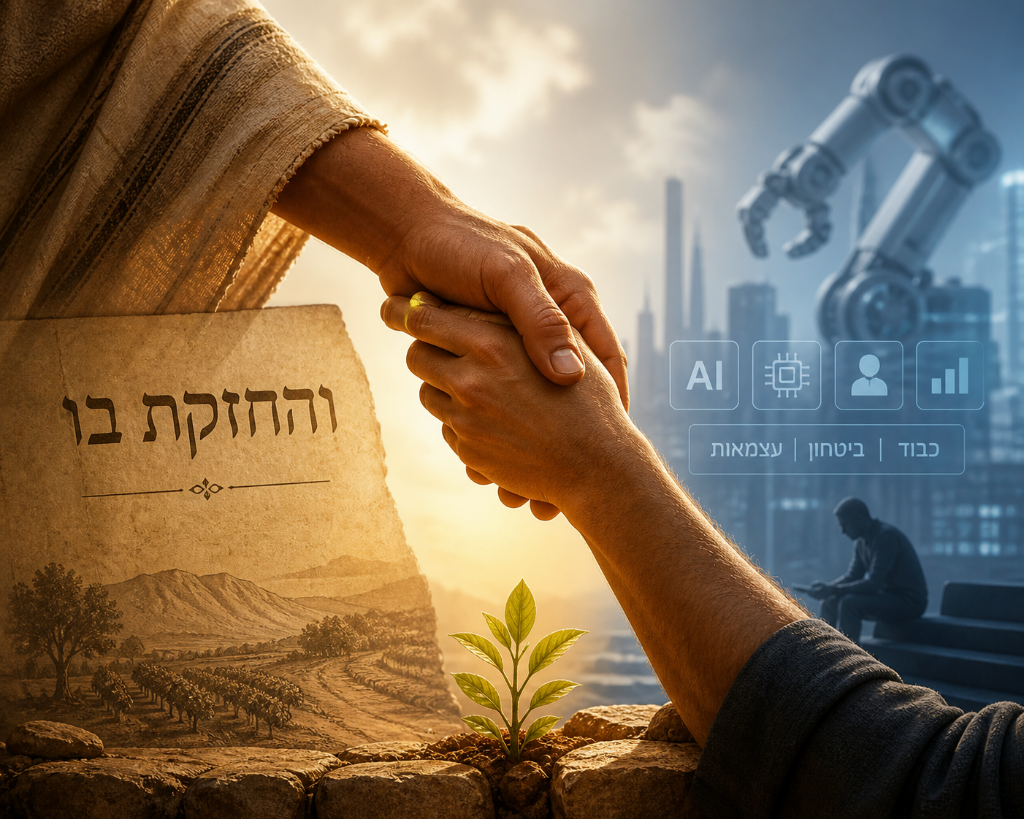
In the end, Parashat Ki Tissa is a question about what human beings are capable of building, and why. Israel built a calf, but they also built the Tabernacle. Both constructions are deeply human — one a rebellion, one a service. The "Vayakhel" that follows Ki Tissa, "And Moses gathered all the congregation of the children of Israel" (Exodus 35:1), stands in contrast to the "the people gathered against Aaron" of the sin of the Golden Calf. The right assembly, for the right purpose, at the right time — that is the difference between a molten calf and the Ark of the Covenant. Artificial intelligence is a tool. Like every tool, the question of intention — the "what for" — is what will determine whether we have built a golden calf or a Tabernacle.