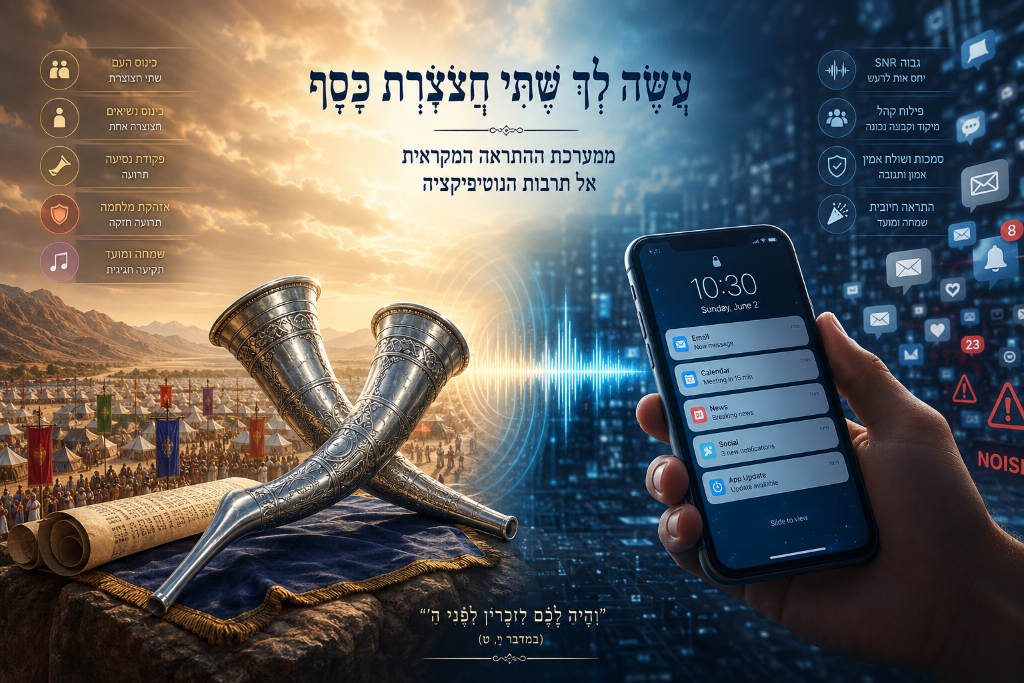
What AI Should Learn From the Greatest Census in the History of Israel
The Bamidbar (Numbers) Torah portion opens with a command to count the people of Israel — not as a collection of data, but each one by their name. What does the ancient census teach about data collection, privacy, and AI alignment?
In an era where billions of data points are collected every day, at a time when artificial intelligence systems define people by behavioral patterns, scores, and statistical characteristics — the Bamidbar (Numbers) Torah portion opens with a deep and complex command: to count the entire people of Israel. Not as a collection of data. Each and every one, by their name.
A. Why Count — And What is the Difference Between Counting and Harming
Rashi, on the opening verse of the book, raises a question that may seem naive but is very deep: Why did God command a counting right now, just a month after the establishment of the Tabernacle? His answer reveals an entire paradigm:
Because they are dear to Him, He counts them all the time. When they left Egypt He counted them, and when they fell at the incident of the Golden Calf He counted them to know the number of the survivors, when He came to rest His Divine Presence upon them He counted them.
Rashi, Bamidbar 1:1
In other words: Counting is not a managerial mechanism. It is an expression of closeness. Just as a person who loves something returns to it again and again — so God counts His people. Counting is an act of affection.
But an unsettling comparison immediately arises: When King David commanded a similar census, it ended in disaster. Seventy thousand people died in a plague (II Samuel 24). The plague in David\'s time — as commentators explain — stemmed from the fact that the counting was done unnecessarily, out of pride and a lust for power, and not by divine command.
Technological Parallel: This is exactly the question being asked today in ethics committees of technology companies: Who orders the collection of data, and for what purpose? Focused and authorized collection is a tool; endless collection out of a lust for power is a danger. The Torah portion distinguished between the two 3,000 years before the European GDPR tried to do so.
B. "Lift the Head" — Moving from a Number to a Person
The precise command in the Torah is not "count" and not "number". It is "lift the head of the entire congregation of the children of Israel" — lift the head of each one. Nachmanides (Ramban) in his commentary brings Rashi\'s understanding, and alongside it the interpretation of the Midrash Vayikra Rabbah:
"Lift" is merely an expression of greatness. As they say: Lift this one\'s head — elevate his status.
Ramban on Bamidbar 1:2, in the name of Vayikra Rabbah
According to this interpretation, "lift the head" is not a counting — it is an elevation of status. Do not reduce people to data points; elevate each one, look them in the face, dare to treat them as a subject.
Here a deep paradox of the AI era is revealed: The more accurate systems become in analyzing human behavior, the flatter the representation of the person they create. A model that knows that "user #4,892,101 buys coffee in the morning at 7:43" knows, but doesn\'t know. It did not "lift their head".
Technological Parallel: What engineers today call "explainability" and "human-in-the-loop" is a technical translation of the same principle: The algorithm will not decide a person\'s fate alone without someone seeing them, hearing them, lifting their head.
C. The Banners — When Architecture is a Declaration of Values
The tribes are not just counted — they are arranged. Four camps, each camp with a banner, each banner with a fixed order. Chapter 2 of the book is a detailed camp plan: who camps in the south, who in the east, who leads the journey, who brings up the rear. There is no coincidence. Every location is significant.
In the technological world, the "architecture" of a system — how information flows, who determines what, what values are embedded in default settings — these are not merely technical decisions. They are value-based decisions. When a platform decides that the algorithm maximizes "engagement" above all else, it has already chosen a value — even if it didn\'t say so.
The children of Israel shall pitch their tents, every man by his own camp, and every man by his own standard, according to the ensigns of their fathers\' houses; at a distance from the Tent of Meeting shall they pitch their tents round about.
Bamidbar 2:2
Note: The order is defined in relation to the Tent of Meeting — not in relation to the government, not in relation to the army, not in relation to logistical convenience. The center of the camp is holiness. The entire structure draws its direction from it.
Technological Parallel: The question of "alignment" — how to ensure that an artificial intelligence system is aligned with human values — is precisely the question of the center: What stands at the center? If the answer is "money" or "number of users" — the architecture is already flawed. The banners draw direction from the center, and not the other way around.
D. The Levites Who Were Not Counted — The Exception That Defines the Rule
The first chapter ends on a surprising note: "Only the tribe of Levi thou shalt not number, neither shalt thou take the sum of them among the children of Israel" (Bamidbar 1:49). The Levites are not in the military census. They are not in the array of banners. They are outside the count.
Nachmanides explains that Moses himself did not know at first what to do with the Levites — they did not receive a leader like the rest of the tribes, and therefore were not counted initially. Only after Moses finished all the other counted ones did God explicitly exclude the Levites from the rule.
The Levites were excluded from the military census array not because they are "less important" — but because their role is different. They serve the Tabernacle. Including them in the same metric of "military power" would have been a categorical error. There is a role that is not measured on the same scale.
Technological Parallel: One of the hot questions in the AI world is: What should not be measured? What should not be included in the optimization loop? Creativity, empathy, spiritual leadership — when trying to "quantify" such things, not only is the measure of measurement wrong, but the very measurement destroys the measured thing. The Levites were not counted not because they were forgotten — but because they are fundamentally different.
E. "By Their Polls" — Privacy as a Torah Principle
The counting was done "by their polls" (skulls) — meaning, everyone passes individually, gives a half-shekel, and is counted personally. Not a mass counting. Not a quantitative analysis. One person at a time.
The Sages explain (Babylonian Talmud, Yoma 22b) that the reason for counting by shekels and not directly is — "because the counting is subject to the evil eye". In today\'s language: Concentration of information and large numbers creates vulnerability. The "evil eye" of direct counting is exactly what is defined today as an "attack surface" — the place where concentrated information becomes a target.
The ancient solution — count the shekels, not the people — is exactly what encryption and differential privacy are trying to achieve: collect useful information without exposing the individual.
Technological Parallel: The "half-shekel" as a proxy for counting — and not the direct counting — is an anonymization mechanism. Instead of recording "a certain person exists", you record "one more shekel arrived". The person is hidden behind the token. This is an idea where a level of privacy is maintained without giving up the legitimate need for the data.
What the Torah Portion Leaves Us Saying
The Bamidbar Torah portion is not a data book. It is a description of a people counted by One who loves them, by explicit command, in a method that protects the individual, while recognizing that there are things that must not be measured. In 2026, when each of us is sorted by hundreds of parameters — not by the hand of God, but by the hands of algorithms whose goal is maximized in money — the Torah portion reminds us: True counting lifts a head, it does not lower a person to a point.
Related Articles

Have We Reached the Days of Resurrection? A Question Technology Forces Us to Ask
8 min
The Digital Exodus: Artificial Intelligence, Liberation from Drudgery, and the Question of Freedom in the Age of Automation
15 min