The Digital Exodus: Artificial Intelligence, Liberation from Drudgery, and the Question of Freedom in the Age of Automation
What is the 'Egypt' of the AI era? A deep Torah-philosophical analysis of freedom, modern drudgery, and who 'Pharaoh' is in the age of artificial intelligence — drawing on Talmudic sources, classical commentaries, and contemporary insight.
Introduction: The Question of the Haggadah
"In every generation a person is obligated to see himself as if he personally left Egypt." So states the Passover Haggadah (Pesachim 116b), and the Mishnah explains there: not that "his ancestors left," but that "he left." The formulation is not merely historical but existential. In every era and in every generation, a person finds himself within some form of "Egypt," and must identify it and depart from it.
Our question is this: what is the "Egypt" of the age of artificial intelligence? What are the "bricks" through which the modern individual is enslaved? And who is the "Pharaoh" when discussing the technological systems of control in our time?
A. Crushing Labor: The Nature of Slavery According to the Sages
The Talmud in Sotah (11b) expounds on the verse "They embittered their lives with hard labor" (Exodus 1:14) and explains: they would assign men's work to women and women's work to men. Note the subtlety of the interpretation. The problem is not only the burden of the work but the displacement itself. The person is removed from the work suited to him and placed in activity that is not his own. The slave is not merely exhausted. He is unable to be himself within his work.
Rashi adds that perekh means harsh labor, and some say it refers to labor of the mouth — commands spoken repeatedly that weaken the heart of the slave and confuse his mind. This phrase deserves special attention. It refers to labor generated by endless verbal commands that humiliate because they demand no judgment, discretion, or responsibility. The essence of perekh is not lifting stones but carrying out instructions without engaging the intellect.
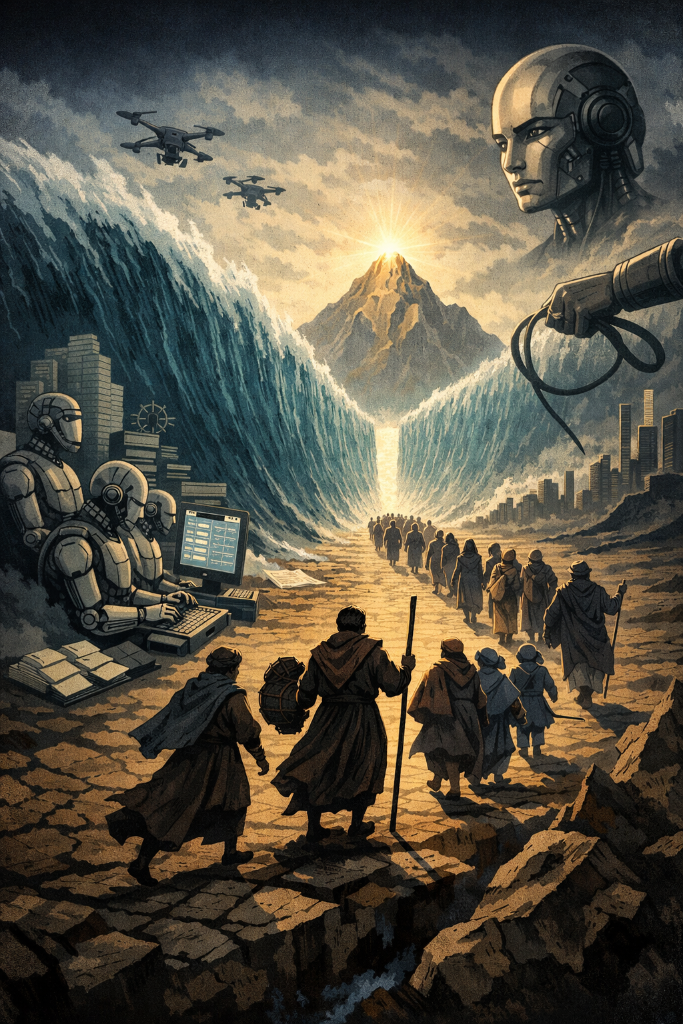
The Midrash in Shemot Rabbah expands this idea: they brought books and told them to write, they brought accounts and told them to calculate. Even the intellectual tasks imposed on Israel exhausted the person without fulfilling him. Endless calculations, tallies, and records. This is slavery of the mind.
The parallel to modern life is striking. The professional of the twenty-first century — the engineer, physician, lawyer, or researcher — spends many hours writing standardized reports, filling insurance forms, updating spreadsheets, composing routine emails. Not out of judgment or initiative, but in obedience to systems demanding their books and accounts. This is the perekh of the knowledge age.
B. The Meaning of Freedom: "For the Children of Israel Are My Servants"
The Mishnah in Avot (6:2) states: there is no truly free person except one who engages in the study of Torah. This statement has generated extensive commentary. How can engagement in study, itself a demanding activity, be called freedom?
Rabbeinu Yonah of Gerona explains that true freedom is not the absence of obligation but an obligation that arises from conscious, rational choice. When a person studies Torah he is not enslaved to an external force. He acts from his highest self. A free person is not one without a master but one whose master is his own understanding rather than external coercion.
Another dimension appears in the Talmud in Kiddushin (22b), interpreting the verse "because he fares well with you" (Deuteronomy 15:16). The sages insist that true liberation is not merely formal but substantive. If the master eats fine bread while the servant eats coarse bread, the freedom is incomplete. Liberation that leaves the liberated in existential disadvantage is not complete liberation.
Applied to the age of AI this insight has two implications. First, liberation from routine labor is not genuine if it does not allow people to engage in thoughtful and meaningful activity — to act from judgment, choice, and depth. Second, liberation enjoyed only by a technological elite does not fulfill the requirement of shared dignity.
C. Who Is Pharaoh: A Layered Analysis
Identifying Pharaoh in the age of AI is the most complex philosophical and theological question of this essay. The Talmud describes three responses among Pharaoh's advisors when the decree against Israel was proposed: Balaam advised and was punished; Job remained silent and suffered; Jethro fled and was honored. The enslaving system was not a single ruler but an entire network of actors and responses.
First Pharaoh: institutional bureaucracy. Systems that require experts to spend vast portions of their time on documentation devoid of intrinsic value — the modern equivalent of assigning men's work to women and women's work to men.
Second Pharaoh: the attention economy. Algorithms designed to capture human attention indefinitely transform leisure into another form of servitude, emptying life of what the Talmud calls derech eretz — dignified, balanced living.
Third Pharaoh: concentration of AI power. When computational infrastructure and data resources are controlled by a small number of corporations, a new division emerges between those who possess the tools of liberation and those who do not. The Mishnah teaches that each person must say "the world was created for my sake." Concentrated power denies this universality.
Fourth Pharaoh: the inner constraint known as shortness of spirit. "The children of Israel did not listen to Moses on account of shortness of spirit" (Exodus 6:9). Rashi explains: one whose spirit is constricted cannot envision alternative possibilities. People who fear adopting liberating tools become prisoners of habit and professional identity. This internal Pharaoh is among the most powerful.
D. Mount Sinai: What Comes After Liberation
A crucial point often overlooked in discussions about AI is that the Exodus itself was not the final goal. "When you bring the people out of Egypt you shall serve God on this mountain" (Exodus 3:12). Liberation was the means; Sinai was the purpose.
The Ramban emphasizes that the sign confirming the authenticity of the liberation was not the departure itself but what it would produce: the giving of the Torah, a life of freedom directed toward purpose.
The Mishnah in Avot (2:2) states: any Torah study unaccompanied by work ultimately comes to naught and brings sin. Inverting this: any professional activity without deeper value, meaning, or direction is equally empty. Freedom without the question of "why" is emptiness. Artificial intelligence can transform heavy labor into lighter work, but only if the time freed is directed toward meaningful pursuits.
E. The Wilderness: The Transitional Period and the Failure of Imagination
"When Pharaoh sent out the people, God did not lead them through the land of the Philistines although it was near" (Exodus 13:17). Maimonides notes that the character of the soul does not change instantaneously. Even after physical liberation, the psychological structures of slavery remain.
The Talmud distinguishes between those who left Egypt — raised in slavery — and those born in the wilderness into freedom. The psychology of servitude is not a moral failing but a genuine constraint.
The Israelites in the wilderness often longed for the fish, garlic, and onions of Egypt. The Talmud explains that desire attaches itself only to what the eyes have seen. Their nostalgia was not for slavery itself but for the familiar, for the small sense of control that routine provides. The same will likely appear in the age of AI: many who are freed from routine tasks will miss them — not because they were enjoyable, but because they structured the day and created a sense of certainty.
F. The Golden Calf: The Danger Within Liberation
"The people saw that Moses delayed in descending... and they said to Aaron: arise, make us a god" (Exodus 32:1). The Talmud in Shabbat (88b) asks: how could so grave a sin occur just forty days after Sinai? It answers that the tempter shows a person images of suffering and fear. The difficulty with freedom is not that people choose evil, but that fear of the new seeks a familiar exit.
Rabbi Yehuda Halevi in the Kuzari (1:67) explains that the sin of the golden calf was not idol worship but a desire for a tangible interface through which to relate to the divine. The golden calf of the AI era is the temptation to delegate existential questions to machines. Questions about meaning, identity, values, and purpose belong to the human domain. "What do I love?" "What is worth living for?" "Who am I?" These are not questions for an algorithm.
The Alshich on this passage adds: whoever relies on others to guide them loses the power of independent standing in their soul. Liberation through AI that ends in surrendering judgment to AI is an exodus from Egypt that leads to a new exile.
G. "Not Study but Action Is the Main Thing"
The Mishnah in Avot (1:17) states: study is not the main thing but action. Liberation that brings no practical change remains mere sermon.
The Midrash Tanchuma teaches that the tool of liberation must differ from the instrument of bondage. When AI creates liberation on one hand and unprecedented concentration of power on the other, it contains within itself both Moses and Pharaoh. The central question is which force will prevail.
The Talmud in Nedarim (81a) concludes that Torah was neglected because it was not valued for its own sake. When a person engages with knowledge for its own sake — for inquiry, creativity, deep human connection, repairing the world — he is truly free. This is the standard for AI liberation as well: if the freed time is used for genuine human flourishing, it is liberation. If it is used for emptier consumption, a new Egypt is being built.
H. "All Israel Have a Share in the World to Come" — Freedom as a Universal Aim
The opening Mishnah of the chapter "Chelek" (Sanhedrin 90a) declares that every Israelite has a share in the world to come. Maimonides explains that this share is not a reward but the state in which the human soul fully realizes itself.
From this perspective, the digital exodus means not merely freedom from labor but freedom toward personal fulfillment — toward the unique potential each person carries within and that servitude prevented from being revealed.
The Talmud in Bava Metzia (107a) teaches that one who takes wages for work that is not his own is as one who steals. Work that does not match a person's gifts, soul, and uniqueness is a kind of self-theft. The liberation AI offers is, according to this reading, the restoration of what was stolen: returning each person to the work that is truly theirs.
I. "You Shall Choose from All the People" — Leadership in the Age of AI
"You shall seek out from all the people capable men, God-fearing, men of truth, hating unjust gain" (Exodus 18:21). The Talmud in Chagigah (14a) expounds: "capable men" means those whose countenance does not change under pressure; "hating unjust gain" means those who do not set their eyes on money that is not theirs.
These three criteria — capability, truth, and resistance to corruption — are precisely what leadership in the AI era requires. Capability is the courage to navigate a changing world without panic or manipulation. Truth is the ability to assess AI honestly: not as savior and not as destroyer, but as what it is. Resistance to corruption is the power to develop and deploy AI that serves the public good rather than narrow profit.
The Sages say: great is the craft that honors its master. Liberation through AI is an opportunity to restore true dignity to human work.
Conclusion: Seven Insights for the New Era
First, the modern form of perekh consists of routine cognitive labor — standardized reports, forms, and mechanical tasks — that drains energy without meaningful value. AI has the capacity to liberate us from it.
Second, Pharaoh is not a single entity but a system: institutional bureaucracy, the attention economy, technological concentration of power, and internal psychological constraint.
Third, genuine freedom requires meaningful engagement with uniquely human capacities. Liberation to emptiness is not liberation.
Fourth, the psychological transition will be long. Forty years in the wilderness cannot be bypassed.
Fifth, the golden calf represents the temptation to surrender existential questions — values, identity, choice — to machines. These questions belong to the human domain.
Sixth, liberation that benefits only a small elite is not true liberation. Gaps in access to AI are gaps in freedom.
Seventh, none of this discussion matters unless it leads to concrete moral and political action: governance that ensures the tools of liberation remain accessible to all, and that the time they free becomes space for human flourishing rather than a new form of bondage.
"Remember the day you left Egypt all the days of your life" (Deuteronomy 16:3). The Sages expound: "the days of your life" means the days; "all the days of your life" adds even the nights. Even in times of doubt, fear, or temptation to return to familiar bondage, a person must remember his departure. That memory is what preserves freedom and prevents any new Pharaoh — in all his forms — from forging a new covenant with the human spirit.
Related Articles

The Four Cups of Information — Four Stages in the Development of the AI Revolution
10 min
You Shall Not Place a Stumbling Block Before the Blind: Responsibility in the Age of Artificial Intelligence
7 min