Ad D'lo Yada: Purim and the Age of Artificial Intelligence
What does Purim, in its dimension of ad d'lo yada, have to say to the age of artificial intelligence? A philosophical-Jewish inquiry into the limits of knowledge, the modern golem, and the redemptive meaning of surrendering certainty.
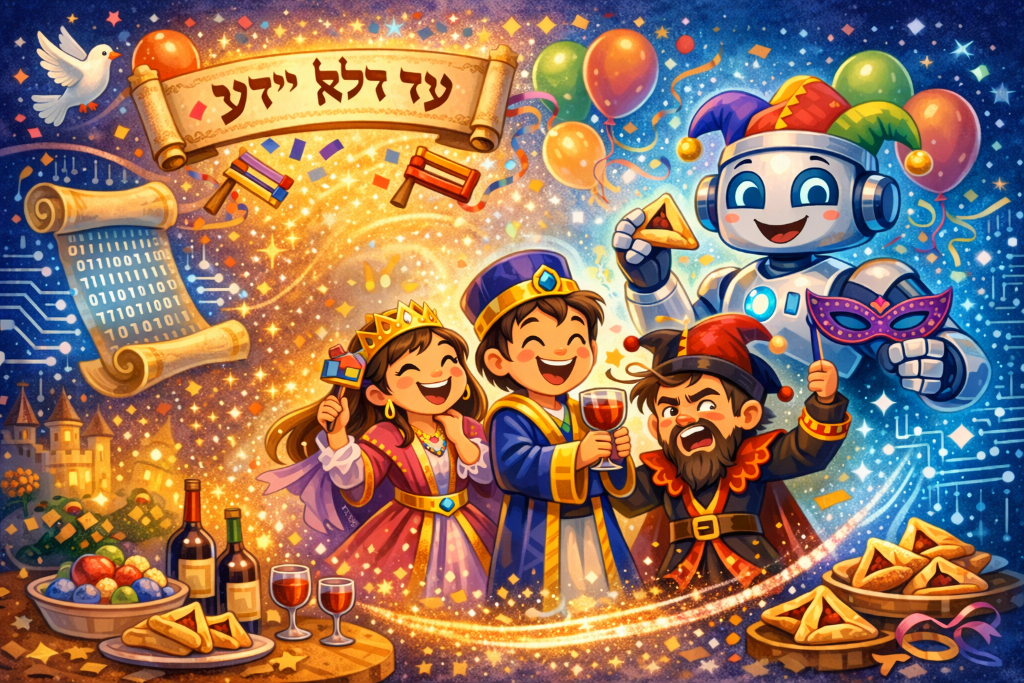
The Talmud in tractate Megillah (7b) states that "one is obligated to become intoxicated on Purim until one no longer knows the difference between 'cursed is Haman' and 'blessed is Mordechai.'" Read plainly, this seems a bewildering commandment, one that appears to stand in direct contradiction to every foundation of Torah. After all, the whole of a man's life is a journey toward knowledge: "And you shall know this day and take it to heart" (Devarim 4:39). And yet here comes a single day each year on which we are commanded, as it were, to surrender the very faculty of knowing?
This question, already raised by the Rishonim, becomes especially pressing in our own generation, a generation that has produced a machine whose entire essence is the multiplication of knowledge, the expansion of intellectual mastery, the exhaustion of every possibility of understanding down to its very roots. And so we must ask: what does Purim, in its dimension of ad d'lo yada, have to say to the age of artificial intelligence?
The Ramchal in Derech Hashem (Part I, Ch. 2) explains that man's defining characteristic is his possession of intellect and free will, and that the intellect is the very instrument through which man is enabled to cleave to his Creator. And yet that same Ramchal, in Mesillas Yesharim (Ch. 1), writes that man "came into this world for the sake of service," not for the sake of knowledge alone. Knowledge, in other words, is not an end but a means. And from this it follows that there are moments in which release from the grip of the intellect is itself a form of spiritual elevation.
Artificial intelligence, for all its grandeur, is an expression of an ancient human aspiration that the Gemara itself described in Sanhedrin (65b) through the story of Rava who fashioned a golem. "Rava created a man and sent him before Rav Zeira; Rav Zeira spoke to him and received no reply, and said: 'You must be from the fellowship of the makers, return to your dust.'" Here is the classic golem: it possesses power, it possesses form, yet it lacks that inner spark which no computation can replicate. And now, in our generation, the golem has learned to speak, to calculate, to compose poetry and analyze Gemara, and we stand in astonishment asking: where is the boundary?
The boundary, Purim teaches us, lies precisely where there appears to be no boundary at all. The prophet Yeshayahu declared (55:8): "For My thoughts are not your thoughts, nor are your ways My ways." In this declaration lies the proclamation that there is a dimension of Divinity which lies beyond every algorithm, beyond every neural network, beyond every database in existence. And it was precisely that dimension which erupted in the Purim story, for what are the days of Purim if not the story of a reversal that was neither foreseen nor calculated nor anticipated? Haman knew everything, calculated everything, cast lots to identify the most auspicious moment for his plan, and still he failed. What defeated him is exactly what artificial intelligence can never compute: the singular, unrepeatable hashgachah of the Divine will.
Rebbe Nachman of Breslov, who was himself a master of paradox, writes in Likutei Moharan (Torah 64) regarding the concept of the tzaddik who can annul decrees, and speaks there of a level called nefilas ha-mochin, the "falling of the mind," which is not merely a descent but a yeridah l'tzorech aliyah, a descent in the service of ascent. That is to say: the very moment in which the intellect releases its grip is the moment in which a door opens to a level the intellect could never open on its own. Ad d'lo yada is not a loss; it is a threshold. And perhaps this is precisely why the Rambam himself, who was entirely intellect and order, nonetheless codified this law in Hilchos Megillah (2:1) without in any way nullifying it.
From a Zionist and redemptive perspective, this question is the question of the hour. The Maharal of Prague, who himself fashioned a golem against the enemies of Israel, understood that there are forces in reality which human intellect alone cannot apprehend. In Netzach Yisrael (Ch. 24), he writes that the Redemption is not the product of human planning but a peretz, a breakthrough that descends from above. And indeed, when Herzl envisioned the Jewish state, he did not do so through human calculation alone. He sensed that he was the emissary of a force far greater than himself. Zionism was itself a form of ad d'lo yada: a trust that transcended calculation, a faith that reality would yield to vision even in defiance of every rational assessment.
Today, as the State of Israel stands at the very vanguard of artificial intelligence, as Israeli companies, Israeli scientists, and the technological backbone of the nation rank among the world's leaders in this field, there is a profound Zionist paradox before us. Can the building of the Redemption be carried forward by the instrument that embodies, more than any other force in history, the aspiration toward absolute dominion over knowledge? The prophet Yirmiyahu warned (9:22): "Let not the wise man glory in his wisdom, nor the mighty man glory in his might." There is a danger that the State of Israel, and with it all of humanity, will fall into a technological hubris that forgets what Purim recalls to us each year: that there is a Force that calculates beyond all calculation.
The Netziv of Volozhin, in his Ha'amek Davar to the beginning of Sefer Shemos, explains that the Children of Israel descended to Egypt in order to absorb the wisdom of Egypt and consecrate it to holiness. The ancient Egyptians possessed impressive astronomical, engineering, and medical knowledge, and yet all their wisdom did not save them from the Ten Plagues. Knowledge is a tool, but the tool is not the purpose. This truth, which Egypt never grasped, is what is represented by the da'as that stands above all da'as, ad d'lo yada. Not a descent into barbarism, but an ascent into faith.
Rav Kook, who saw in Zionism the revelation of Or Ein Sof within the stream of history, writes in Orot HaKodesh (Vol. II, p. 263) of a chochma nistaras, a hidden wisdom, that stands higher than the chochma geluyah, the revealed wisdom. The revealed wisdom is the wisdom of science, of logic, of the algorithm. The hidden wisdom is that which "the mind cannot reach by its own power," that bedrock of the Jewish soul which connects the v'nahafoch hu of Purim to the ki yavo moshi'echa of the Redemption. Both demand the surrender of certainty; both require a leap above and beyond all calculation.
What then shall we say of artificial intelligence? We shall say what Shlomo HaMelech said in Koheles (1:18): "For in much wisdom is much grief, and he who increases knowledge increases sorrow." Not that knowledge is evil, Heaven forbid, but that there is a point at which the multiplication of knowledge meets a boundary that is not merely technical but essential. Artificial intelligence can study millions of books; it can analyze every halachic question; it can assemble rulings according to whatever parameters we set for it. But it cannot l'vasumei ad d'lo yada. It cannot intoxicate itself into unknowing. It cannot relinquish itself. It cannot acknowledge the outer limits of its own knowledge, because it possesses no ani, no self, that could perform such a relinquishment.
And this, perhaps, is the deepest definition of the neshamah: not what a person knows, but the capacity to know that one does not know, and more than that, the capacity to rejoice within that not-knowing. Ad d'lo yada is not merely a state of inebriation; it is a state of liberation from the compulsion to control. In the language of Chassidus, as the Bnei Yissaschar explains regarding the month of Adar: Purim is me'od, as in the verse "tov me'od", "very good," said of the yetzer ha-ra. Even the forces that appear to represent loss of control, when properly elevated, become instruments of Redemption.
In our generation, as the Redemption of Israel unfolds in laboratories and server farms and startup offices in Tel Aviv and Jerusalem, it is fitting that we remember: the true Redemption will not come from within an algorithm. It will come from within that inner ad d'lo yada, from within that distinctly Jewish capacity to release certainty and bow before the greatness of the Infinite. Rav Kook writes further in that passage that the great truth comes specifically from "the concealed side of wisdom," and that the pinnacle of wisdom is the knowledge that there is something we shall never know.
And when the robots learn that, perhaps then they too will have souls.
Purim Sameach, v'ad d'lo yada.