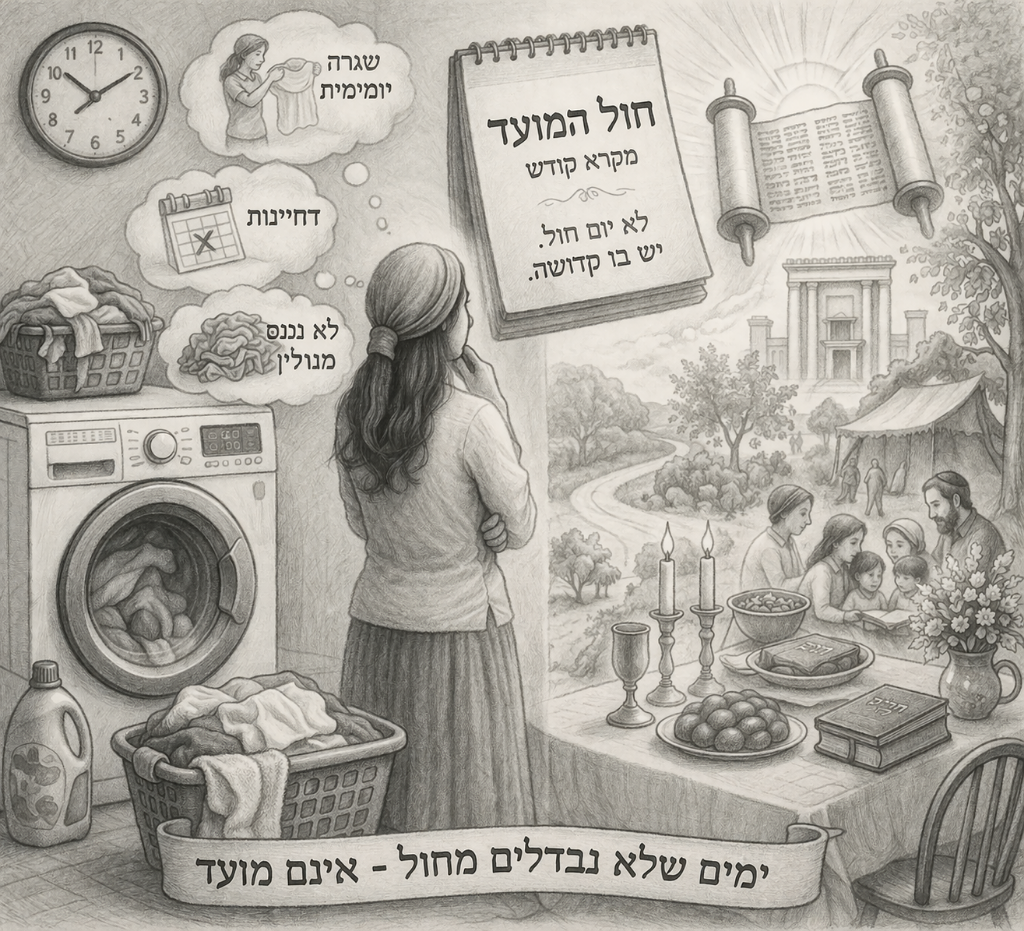
Laundry on Chol HaMoed — Between Halacha, Tradition, and Common Sense
Is doing laundry on Chol HaMoed really forbidden? To understand this prohibition, we first need to understand what Chol HaMoed actually is, and what lies behind all its labor restrictions — three reasons that have stood the test of generations.
Introduction
"You can't do laundry on Chol HaMoed?!" How many times have you heard that sentence, immediately followed by eyes rolling toward the heavens. After all, there's a washing machine at home, the laundry basically does itself — so what's the big deal?
To understand the prohibition on laundry, we first need to understand what Chol HaMoed actually is, and what stands behind all of its labor restrictions. Because the laundry rule is not an independent decree that fell from the sky — it is a specific case of a much larger principle.
Part I: What Is Chol HaMoed and Why Is Work Forbidden?
Chol HaMoed refers to the intermediate days of Passover and Sukkot — not a full Yom Tov, but not a regular weekday either. And that is precisely where the interesting tension lies.
The Torah emphasizes, both regarding the Festival of Matzot and the Festival of Sukkot, that on the first and last days "it shall be a holy convocation for you; you shall do no laborious work." However, regarding the intermediate days of Chol HaMoed, the Torah does not explicitly state that work is forbidden. Yet because these days fall between two sacred days, they are also called "holy convocations," and special offerings are brought on them — it is forbidden to work during them as one would on ordinary weekdays. There is, however, a distinction: on Yom Tov all laborious work is forbidden, whereas on Chol HaMoed only certain categories of work are prohibited.
The Rambam explains the reasoning behind this prohibition in a way that remains relevant to every generation: "Chol HaMoed, even though the Torah does not explicitly state rest, since it is called a 'holy convocation' and is a time of festivity in the Temple, work is forbidden — so that it should not be like the rest of ordinary weekdays, which have no sanctity at all."
Pay attention to the phrasing: "so that it should not be like ordinary weekdays." The reason is not punishment, nor an arbitrary decree — it is a definition. A Chol HaMoed that is indistinguishable from a regular weekday is simply not Chol HaMoed.
Does the Prohibition Come from the Torah or the Rabbis?
This is a question the Sages debated, and it has practical implications. Some hold the prohibition is rabbinic in origin — including Rabbeinu Tam, the Rambam, and the Rosh. However, many authorities read the Talmud at face value and rule that performing work on Chol HaMoed is a Torah-level prohibition — including Rashi, the Rashbam, and the Ramban.
The Beit Yosef writes: "The prohibition of labor on Chol HaMoed is Biblical, except that the Torah delegated to the Sages the authority to specify which labors are forbidden and which are permitted."
This is a remarkable principle: the Torah prohibited, but handed authority to the Sages to fill in the details. And so there are labors that are permitted (such as those needed for food preparation, to prevent significant loss, or for communal needs) and those that are forbidden.
Effort as the Measuring Standard
One of the central principles that emerged from the halakhic discussion: on Chol HaMoed, it is the exertion that is forbidden. Labor involving significant effort is prohibited; labor that does not involve significant effort may be permitted. Anything that entails undue toil and is not necessary for the holiday itself, the Sages prohibited doing publicly on Chol HaMoed — so that people may rejoice on the holiday and not treat it lightly.
Part II: Laundry — A Specific Case of a General Principle
Now, having understood the foundation, the prohibition on laundry makes complete sense in a new light.
Laundry is labor — whether done by hand or by machine — that ties a person to the routine of the work week. It is not "food preparation," it is not "preventing significant loss," and it is not a need of the holiday itself. And if it is not needed for the holiday, why should it be permitted?
The Talmud in Tractate Moed Katan clarifies the specific reasoning behind the laundry prohibition: "As we learned: the men of the priestly division and the men of the ma'amad are forbidden to cut their hair and do laundry… What is the reason? So that they should not enter their service in a state of dishevelment. Here too, so that people should not enter the festival in a state of dishevelment."
In other words: beyond the general prohibition on labor, laundry carries an additional specific reason — preventing procrastination. If you know you can do laundry during the holiday, you won't do it beforehand. And you will enter the holiday disheveled.
The Shulchan Aruch rules: "One may not do laundry on Chol HaMoed, even for the needs of the holiday itself. The reason: so that one will do laundry before Yom Tov in honor of the holiday, and not enter the holiday disheveled."
Note the subtle point: "even for the needs of the holiday itself." Meaning, even if you genuinely need a clean garment for the holiday days themselves, the prohibition still applies — because you had the opportunity to prepare in advance.
Part III: Why Both Reasons Together Have Stood the Test of Time
The First Reason: Honor of the Holiday
The Talmud states: "One who disgraces the festivals is as if he worships idols." And Rabbeinu Yona explains: "Since the festivals are called 'holy convocations' in the Torah, one who desecrates them has desecrated what is sacred to God."
Doing laundry is not the great "disgrace," but it is part of an overall atmosphere. A person who does laundry, ironing, and household chores throughout Chol HaMoed is living those days as regular weekdays. And that is precisely what the Sages sought to prevent.
The Second Reason: Preparation Is Part of the Holiday
The Rambam explains that the days of Chol HaMoed are "a time of festivity." The offering of special sacrifices reflects the inner sanctity inherent in these days, and the prohibition on labor allows that sanctity to be given outward expression.
In modern terms: Chol HaMoed is meant to be a time dedicated to celebration, family, good food, trips, and Torah study — not to running the usual routine.
The Third Reason: The Psychology of Procrastination
The Sages understood what behavioral researchers confirm today: when the option to delay exists, people use it. An external constraint is sometimes the only way to enforce early preparation upon ourselves.
The rule is that laundry was only permitted on Chol HaMoed for someone who was unavoidably prevented from doing it before the holiday — but anyone who could have done laundry beforehand and chose not to is forbidden to do it. The prohibition forces preparation. And preparation brings a sense of festivity.
Part IV: What About the Washing Machine?
The common argument — "Laundry today is so easy, what's the problem?" — sounds logical, but it rests on a misunderstanding of both reasons together.
- Regarding the first reason — honoring the holiday and not turning it into a regular weekday — a washing machine changes nothing. The question is not how difficult the laundry is, but whether you are living these days as a holiday or as routine.
- Regarding the second reason — preventing procrastination — a washing machine certainly changes nothing. If you know you can "throw in a quick load" on Chol HaMoed, you won't prepare beforehand.
Since the reason for the prohibition is not only the physical effort involved, but the very character of these days, one cannot dismiss the laundry prohibition simply because technology has made it easier.
Summary
The prohibition on doing laundry on Chol HaMoed is not an isolated decree. It is a specific instance of a larger principle: Chol HaMoed is not a weekday. It is a day imbued with sanctity, and the labor restrictions are the way to give that sanctity practical expression.
Three reasons stand side by side: the honor of the holiday and its expression through abstaining from routine; the prevention of procrastination that leads to entering the holiday disheveled; and the simple definition — days that are indistinguishable from weekdays are not a festival.
And if you nonetheless find yourself standing in front of the washing machine on Chol HaMoed, thinking "just one cycle" — remember that this day is called "a holy convocation." It is not waiting for you to finish. It has already begun without you.
Related Articles

Dina De'Malkhuta Dina and Bitcoin: Between Monetary Sovereignty and Technological Decentralization
12 min
The Four Cups of Information — Four Stages in the Development of the AI Revolution
10 min