

The Four Cups of Information — Four Stages in the Development of the AI Revolution
Like the four cups of redemption on Passover night, the artificial intelligence revolution unfolds in four distinct stages: data collection, model training, contextual reasoning, and co-creation. A deep analysis bridging Talmudic wisdom and contemporary technology.
On the night of the Seder, we drink four cups of wine corresponding to the four expressions of redemption stated in Parashat Shemot: "I will take you out, I will rescue you, I will redeem you, and I will take you."
A question naturally arises: why four? Would one expression of redemption not have been sufficient? Chazal teach us that redemption did not leap in a single step from slavery to freedom. It unfolded in stages. Each cup represents a different internal transition, a deeper level of liberation that could not exist without the stage before it. Rescue without first being taken out is impossible. Redemption without rescue is hollow. Being taken as a nation without redemption would be arbitrary.
Remarkably, each of these technological stages parallels one of the four cups of the Seder. Sit down, pour a cup, and let us begin.
First Cup: "I Will Take You Out" · Extracting the Data · Data Collection
"I will take you out from under the burdens of Egypt." (Exodus 6:6)
Taking something out is a physical act. It is blunt and simple. Something is moved from one place to another. Nothing has been processed yet. Nothing has been understood. It has merely been extracted. Extraction always comes first. Without it, nothing else can happen. One cannot redeem something that still remains inside the prison.
This is precisely how the first stage of every artificial intelligence system works: data collection. Billions of pages of text are gathered from across the internet through automated systems known as web crawlers. These programs travel across the web downloading everything they encounter: books, research papers, Wikipedia pages, forums, tweets, Stack Overflow answers, newspaper articles, blog posts, conversations, and computer code. Everything is collected and stored. At this stage there is no understanding. No conclusions. No question of "why." There is only a massive accumulation of raw material waiting for the next stage.
The challenges here are deeper than they appear. This is not merely a technical question of storage capacity. It raises serious moral questions: What data may be collected? From whom? With whose consent? Much of the information online was created by people who never imagined that one day it would be used to train machines. This is where the debates about copyright, privacy, and representation begin. These questions still lack clear legal answers anywhere in the world.
The parallel to Egyptian slavery is painfully precise. The Israelites labored and built, but the fruits of their labor were not their own. Their bodies served a system they did not choose. Similarly, the data gathered from the internet has been taken from its original home, yet it has not become knowledge belonging to anyone. Extraction without redemption is only the liberation of the body, not the liberation of the spirit.
Second Cup: "I Will Rescue You" · Processing the Data · Training and Optimization
"I will rescue you from their labor." (Exodus 6:6)
Rescue is different from extraction in a subtle but profound way. Extraction moves the body. Rescue breaks the system of slavery itself. The verse does not say "I will rescue you from Egypt," but "from their labor" — from the system that enslaved them, from the paradigm in which a person becomes a servant.
In artificial intelligence, this stage corresponds to model training. The raw data that was collected now undergoes intense computational processing. The computer reads millions of examples and repeatedly attempts to predict the next word. Each attempt fails at first. The error is measured and fed back through a process called backpropagation, making tiny adjustments to the neural network's weights — the billions of numerical parameters that represent the machine's internal structure of knowledge. This process repeats itself trillions of times across thousands of GPUs over weeks or months.
The challenges here are not only computational but interpretive. How much data is enough? How do we deal with biased, inaccurate, or harmful data that entered during collection? In processes such as fine-tuning and Reinforcement Learning from Human Feedback (RLHF), human evaluators guide the model — teaching it not only what is correct but what is helpful, safe, and appropriate. Quietly, the value judgments that shape the personality of the model are established here.
Just as the verse emphasizes rescue from the labor rather than from Egypt itself, the goal here is not merely to store data differently. The goal is to liberate the knowledge hidden within the raw text. Even so, the model still does not truly understand. It has calculated. It has optimized. It has structure. But understanding has not yet emerged.
Third Cup: "I Will Redeem You" · Understanding the Data · Reasoning and Context
"I will redeem you with an outstretched arm and with great judgments." (Exodus 6:6)
Redemption differs fundamentally from rescue. Rescue removes a person from something negative. Redemption connects a person to something new — to a new identity. You now belong somewhere else. You are no longer what you once were.
In the world of artificial intelligence, this cup represents the dramatic moment when machines move beyond mechanical word prediction and begin demonstrating contextual reasoning. A model can now read a complex math question and solve it step by step. It can recognize that two differently phrased questions are asking the same thing. It can hold long conversational context and remember what was said at the beginning.
The technological breakthrough enabling this transition was the Transformer architecture and its attention mechanism. Earlier models processed text sequentially, word by word, like someone reading while constantly forgetting. Attention allows a model to do something more like the human brain: look at the entire text simultaneously and focus on what is relevant. When the model encounters the word "he" at the end of a paragraph, it can connect that word to a name mentioned several sentences earlier. For humans this seems trivial. For machines, it was revolutionary.
At this stage a major philosophical debate begins: does a machine that understands context actually understand, or is it merely producing a convincing simulation? There is no simple answer — much like the debates among the Sages about what constitutes true redemption. Was it the physical Exodus? Entry into the Land of Israel? The giving of the Torah? Each answer captures part of the truth, but none captures it entirely. So too with machine understanding. "With an outstretched arm and great judgments" — the transformation did not arrive quietly. It felt deeper than a simple incremental improvement.
Fourth Cup: "I Will Take You" · Creation and Partnership · Generation and Co-Creation
"I will take you to Me as a people, and I will be your God." (Exodus 6:7)
This is the culmination of redemption. And interestingly, it is the stage least discussed during the Seder. Everyone remembers the Exodus, the plagues, and the splitting of the sea. But the goal of everything was the covenant. Belonging. A relationship. Not merely freedom from oppression, but a genuine partnership. "You shall be My people and I will be your God." A covenant carries obligations for both sides.
The fourth cup corresponds to the stage where artificial intelligence becomes not merely a tool but a creative partner. At this stage, models can generate working code, design complex systems, assist in multi-step reasoning, identify errors in assumptions, and propose entirely new approaches. In emerging agentic systems, models do not merely answer questions. They plan and execute tasks: browsing websites, running code, correcting their own mistakes, and building products.
The greatest challenge here is not technological. It is moral and legal. When God says "I will take you as My people," He accepts responsibility. He enters into a covenant. In contrast to slavery, where the person chose nothing and committed to nothing, a covenant assumes two sides who agree and who share responsibility. Likewise, when AI systems participate in creation, difficult questions arise: Who is responsible for what the model produces? Who bears responsibility when mistakes cause harm? Who answers for hidden biases embedded in systems that few people fully understand? These questions remain unresolved, even as AI systems spread everywhere.
Perhaps that is the deepest lesson of this comparison: the AI revolution will not be complete until society establishes a clear covenant of responsibility — a shared agreement of who owes what to whom.
A Final Question
Chazal did not say we must merely learn about the Exodus. They taught that "in every generation a person must see himself as if he personally left Egypt." Not simply to know the story, but to live it. To experience it from within. Not as neutral observers, but as those who are inside the process, finding their place within it.
The same is true of the revolution of artificial intelligence. We are not watching it from the outside. We are inside it. Some among us are still in the stage of data extraction, building pipelines and gathering raw material. Some are training models. Some are designing systems that reason and understand context. And some are already collaborating with machines to create things that would have been impossible only a few years ago.
The question is not what artificial intelligence will do. The question is: Which cup are we holding right now, and how will we drink it?
Related Articles
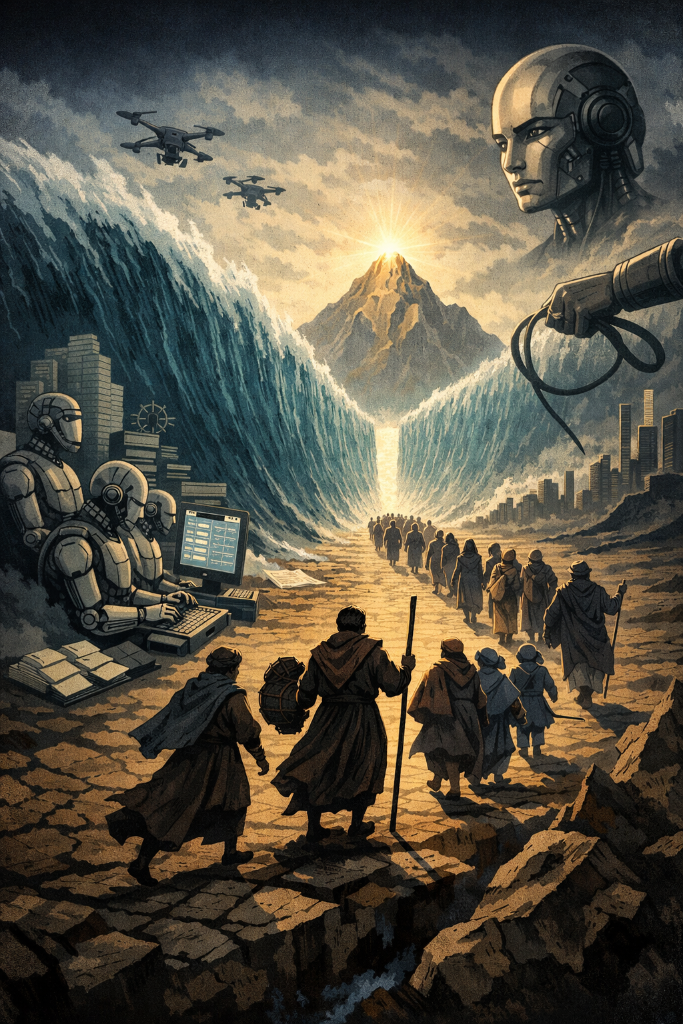
The Digital Exodus: Artificial Intelligence, Liberation from Drudgery, and the Question of Freedom in the Age of Automation
15 min
You Shall Not Place a Stumbling Block Before the Blind: Responsibility in the Age of Artificial Intelligence
7 min