

You Shall Not Place a Stumbling Block Before the Blind: Responsibility in the Age of Artificial Intelligence
Parashat Kedoshim invites us to examine not only what we build, but who will benefit from it — and who will be harmed. An AI developer who asks themselves "Am I placing a stumbling block before someone who does not understand?" is asking a very ancient question.
At the heart of Parashat Kedoshim, a commandment hides whose potential is enormous: "You shall not curse the deaf, and you shall not place a stumbling block before the blind, and you shall fear your God — I am the Lord" (Leviticus 19:14)
Does a person who releases to market an AI-based system capable of generating deepfakes, spreading false information, or misleading people into critical decisions — violate a Torah prohibition?
I. Expanding the Prohibition: From Physical Blindness to Intellectual Blindness
The Sifra, Torat Kohanim on Leviticus 19, already established that the prohibition is not limited to the physically blind: "Before one who is blind in a matter. If someone is seeking advice from you, do not give him advice that is not fitting for him." That is, any person who does not understand a particular subject is considered "blind" for the purposes of this prohibition.
Rashi on the verse emphasizes that it concludes with the words "and you shall fear your God" — a sign that this is a prohibition that is "entrusted to the heart," meaning no other person can know whether the intention was good or bad. Only God knows. The Maharal in Gur Aryeh reinforces this: in physical tripping, the blind person can know who tripped him. But in "intellectual blindness," only God sees.
Sefer HaChinuch, Mitzvah 232, elaborates: "Not to cause the children of Israel to stumble by giving them bad advice... and this prohibition also includes one who assists in a sin or brings it about." That is — not only direct advice, but also indirect assistance in causing someone to stumble.
II. "Before the Blind" in the World of Software and Artificial Intelligence
In today's technological world, who are "the blind"? Almost all of us.
When a developer releases an AI-based product capable of creating a "deepfake" — forged videos that appear completely real, fabricated images, fake texts — he creates a tool whose power and destructive potential the general public does not always understand. The user is "blind in the matter": he does not know how to identify a forged video, does not understand its impact, and is unable to defend himself from it.
According to Maimonides in his Commentary on the Mishnah: "One who deceives him and brings him to a stumbling block, or who commanded him to sin, or who assisted him in it in any way whatsoever, even with a small word — is punished by Heaven." The responsibility does not stop with the villain who uses the tool — it also falls on the one who built it and enabled its use.
III. The Question of "Trei Ivrei D'nahara" — When the Stumbling Block Is Already Accessible
The Talmud in tractate Avodah Zarah (folio 6b) discusses an important question: if a Nazirite can obtain wine on his own, does a person who hands him a cup of wine violate "before the blind"? The answer: only when they are standing "on two sides of the river" — that is, when a person truly cannot reach the prohibition without your help, only then is the Torah prohibition transgressed.
Some will argue: dangerous AI tools are already accessible to everyone everywhere, so there is no problem in releasing yet another one. However, Maimonides' ruling in the Laws of Injury and Damages stands against this: "Even though the one who does the act is the one liable to pay, the one who instructed him is his partner in sin and is considered wicked, for he has caused the blind to stumble." Even if others do harm, that does not permit you to join that same chain of damage.
IV. "And You Shall Fear Your God" — When No Court Will Reach You
One of the most fascinating points in this prohibition is the phrase "and you shall fear your God" — an emphasis that this is a prohibition that cannot always be enforced externally.
A company that releases an open API without restrictions can claim before a court: "I did not know it would be used for harm." However, according to the halachic interpretation, as the Torat Kohanim explains: "You might say I am giving him good advice — but the matter is entrusted to the heart." If you know in your heart that the tool will cause harm, no declaration of "good intentions" renders it permissible.
This is precisely the criticism leveled at AI companies that release models to the market without adequate safeguards. They know — and sometimes privately admit — that the model can be used to cause harm. "And you shall fear your God" leaves no room for evasion.
V. The Threefold Responsibility: Developer, Company, and Regulator
According to the world of Halacha, there are three players in the "before the blind" chain:
- The individual developer — who is obligated to ask: "Will this tool cause to stumble anyone who does not understand its implications?"
- The company — responsible for the policy of releasing tools to market, for red teaming tests, and for oversight mechanisms.
- The regulator — upon whom the prohibition also falls, as Sefer HaChinuch writes: "The root of this commandment is well known, for the repair of the world and its settlement is to guide people and provide them with good advice in all their actions" — even a legislator who refuses to regulate a dangerous field "places a stumbling block before the blind."
The Meshech Chochma expands the prohibition even to "mental and emotional blindness" — a state in which a person is willing to suffer harm due to his desires, his anger, or his lack of understanding. This fits exactly the dynamics of AI: a user who shares a deepfake is not doing so out of malicious intent — he simply does not understand.
The responsibility, according to Halacha, does not fall on "the blind" person who stumbled. It falls on whoever placed the stumbling block.
Conclusion
Parashat Kedoshim invites us to examine not only what we build, but who will benefit from it — and who will be harmed. An AI developer who asks themselves "Am I placing a stumbling block before someone who does not understand?" is asking a very ancient question, one that the Torah formulated thousands of years before the age of artificial intelligence.
"And you shall fear your God — I am the Lord" — even when no court will ever reach you.
Related Articles
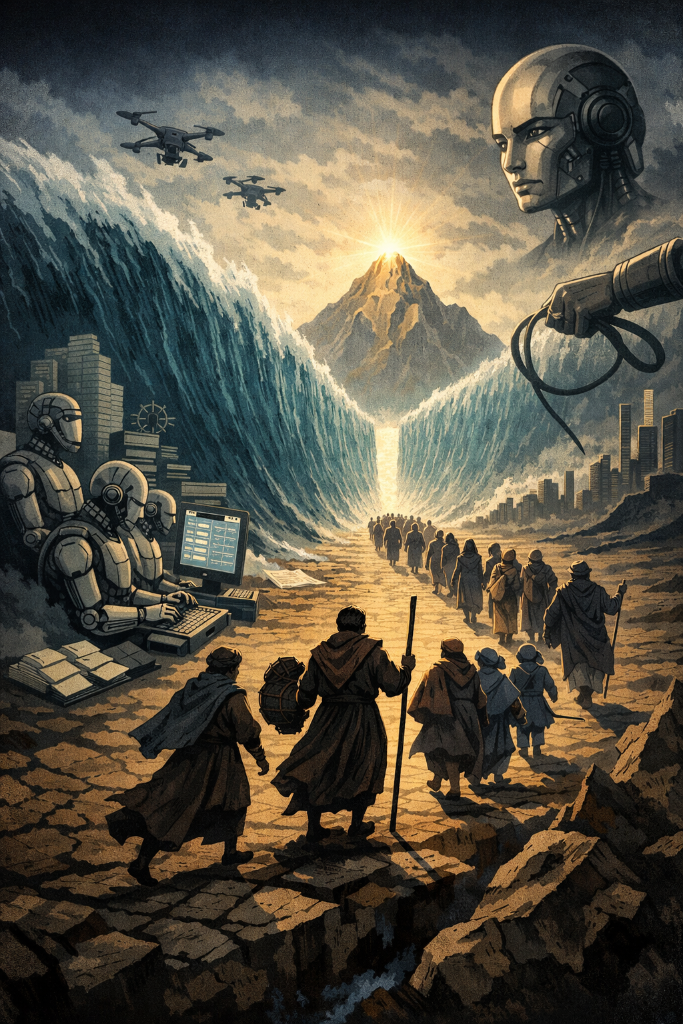
The Digital Exodus: Artificial Intelligence, Liberation from Drudgery, and the Question of Freedom in the Age of Automation
15 min
When the Dead Speak: AI, Digital Memory, and the Virtual Eternal Lives of Fallen Soldiers
7 min