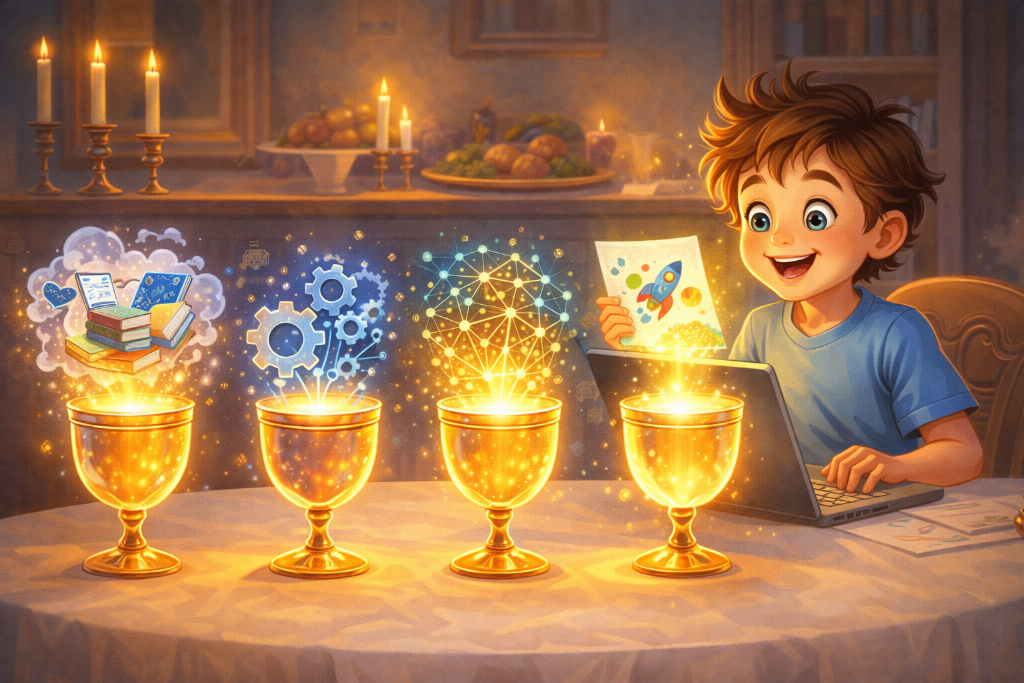
When the Dead Speak: AI, Digital Memory, and the Virtual Eternal Lives of Fallen Soldiers
Technology companies are offering to preserve the voices, movements, and personalities of the fallen forever. Is this comfort? An intrusion into forbidden territory? And what does Jewish law say?
Introduction: A Conversation with Someone Who Is Gone
Imagine this: a bereaved mother sits in front of a screen, types, and receives a response. Not a generic bot response, but a familiar voice, familiar nuances, an inside joke only the two of them ever knew. This is not science fiction. It is happening now.
Companies like HereAfter AI, StoryFile, and You, Only Virtual are offering to preserve a person's "selfhood" after death, based on hours of recordings, messages, social media posts, and algorithms that learn behavioral patterns. The bereaved families of IDF soldiers who fell in the Iron Swords War are exactly the audience this technology speaks to — and that cannot be ignored.
What Is "Digital Memory," Exactly?
The technology operates on several layers. At the basic level: archiving — saving messages, photos, videos, and playlists. At the advanced level: an AI model trained on all of this data, capable of simulating conversation, answering questions, and even behaving "like them" in new contexts. And at the most advanced stage: a three-dimensional avatar that moves and speaks.
The StoryFile project, developed in the United States, has already preserved the testimonies of Holocaust survivors using AI, allowing children to ask questions and receive real answers. Yad Vashem has considered adopting similar technology. The question is: is what is appropriate for Holocaust survivors who died at an advanced age also appropriate for a twenty-two-year-old soldier who fell in Gaza?
What Does Jewish Law Say? Between Comforting Mourners and "Inquiring of the Dead"
Jewish law has engaged for centuries with the question of the boundary between the living and the dead. The prohibition of "inquiring of the dead" (Deuteronomy 18:11) is ruled a Torah-level prohibition against attempting to communicate with the deceased. Maimonides explains that the prohibition concerns "false imagination" — causing a person to believe that the dead are speaking to them.
Rabbi Yuval Cherlow, head of the Ethics Center at the Tzohar Rabbinical Organization and one of the foremost halachic authorities in the field of technology, addressed this issue directly. In his view, the primary problem with digital representation of the deceased lies in the prohibition of geneivat da'at (deception): artificial intelligence enables the construction of personas that say things the person never actually said. Nevertheless, he draws a distinction: if the family clearly knows they are dealing with a simulation and there is full transparency, there may be no prohibition — only an advanced memorial tool. If there is deception, even self-deception, it is dangerous both halachically and psychologically.
The question of respect for the dead also enters the picture. Rabbi Cherlow notes that Jewish law recognizes a person's right over their own limbs and image, and therefore the question of the deceased's own consent is central: someone who did not express their wishes during their lifetime — it is doubtful whether they can be represented digitally, even with good intentions.
An open halachic question: Does a soldier who explicitly consented during his lifetime ("you may use my data for memory preservation") permit this technology? Most halachic authorities have yet to rule, and this is a question already reaching the houses of study.
The Psychology: Comfort or Prevention of Grief?
Even setting aside the halachic question for a moment, psychology speaks loudly. The grieving process, according to every school of psychology from Freud to Kübler-Ross, is based on internalizing the "absence." You lose, you suffer, and gradually you learn to live with the void. It is painful, but it is healthy.
What happens when technology makes it possible not to internalize the "absence"? When a mother can send a message to her fallen son and receive a response "from him"? Researchers at Cambridge University warn of "complicated grief" — endless, unresolved mourning, a dependency on a fictitious presence that prevents genuine healing.
On the other hand, there are testimonies from bereaved families who found enormous resource in video archives of their loved ones: hearing the laugh one more time, seeing the gait, remembering the scent of a personality. This is different from an AI bot that replies: it is authentic testimony, frozen in time, that does not pretend to be alive.
Israel 2026: The Reality Already Here
After the Seventh of October, dozens of bereaved families in Israel began systematically documenting the memory of their loved ones: videos, recordings, interviews. Some did so by instinct, others with the guidance of nonprofit organizations. And questions have begun to arise: what do you do with a fallen soldier's phone? Who has the right to access it? Should it be made public?
The IDF itself has begun recording testimonies of soldiers before operations — not as AI for the future, but as human documents. It is a modest step, but it points in a direction: the state understands that digital memory is a question that must be answered before technology answers it on its own.
Boundaries That Must Be Drawn: Now
There are several questions that Israeli society — both religious and general — must begin to openly discuss: Who holds the digital data of a fallen soldier — the family, the state, or the technology company? Can a soldier stipulate during his lifetime how his digital identity is to be managed after death? Should the IDF establish a clear policy on this matter? And should halachic authorities issue a consolidated ruling before the market dictates the norms?
There is no single correct answer here. There is a sea of genuine, painful, and urgent questions waiting for serious discussion outside of TikTok.
Conclusion: Memory Belongs to the Person, Not the Algorithm
On Memorial Day we stand for a minute or two and hear the siren. It is a deeply human act: the body stops, the heartbeat changes, a tear rises. No AI can replicate that. And no digital avatar can replace the painful knowledge that he is gone.
Technology will offer us more and more ways to "preserve." The challenge for the national-religious generation — and for the Jewish people as a whole — is to decide what is worth preserving, and what should be allowed to rest in silence. True memory is not on a cloud server. It lives in the heart, in the story, in the name spoken on Shabbat.
Related Articles
You Shall Not Place a Stumbling Block Before the Blind: Responsibility in the Age of Artificial Intelligence
7 min
The Law of Distinction for the Digital Generation
9 min